
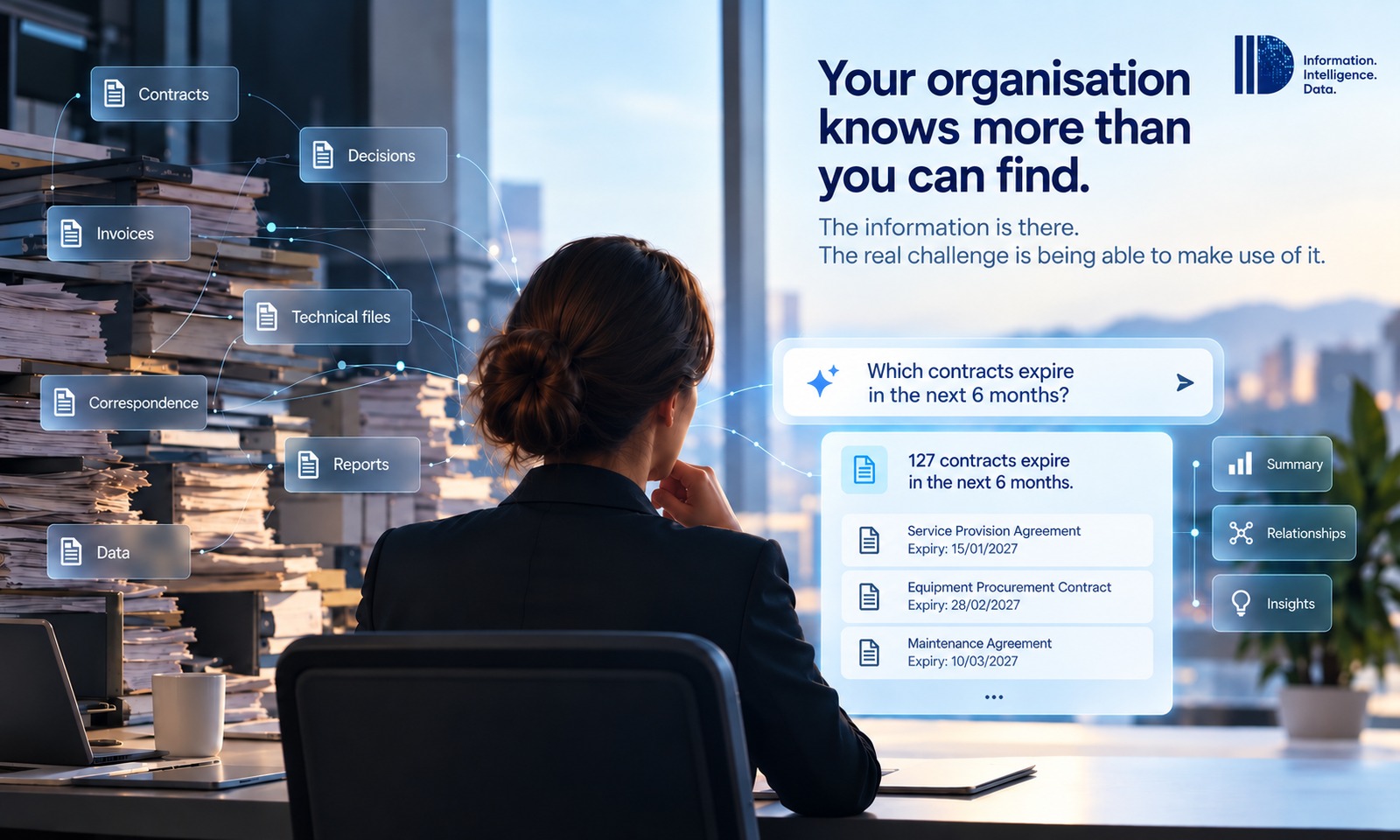
The information is there. The real challenge is being able to make use of it.
Let’s think about a modern organisation. Every day, it creates and manages enormous amounts of information. Documents, contracts, decisions, technical records, invoices, correspondence, reports and data. Over time, all of this information accumulates across information systems, digital archives, databases and different repositories. Digitisation has made this information more accessible, more secure and easier to manage. But as the volume continues to grow, a new challenge emerges: Can we really find what we need, when we need it?
Let’s take a simple example. A director wants to know how many contracts of a particular type are due to expire within the next six months. The information may already exist within the organisation. It may be contained in hundreds or even thousands of digital files. But getting to the answer may require someone to identify the relevant documents, open them, search for the right information and eventually bring the different pieces together. The information is there. The answer, however, is not always easy to find.
From “Where is the file?” to “What do we know?”
For many years, digital search worked in a very specific way: we entered a keyword, found one or more documents, opened them and searched through them for what we were looking for. This works well when the volume of information is manageable. But what happens when an organisation has millions of digital documents? Or when the answer we are looking for is not contained in a single file, but emerges from combining information found across multiple sources?
At that point, search is no longer simply about locating a document. It becomes a matter of understanding information and the relationships between different pieces of it. And this is where technology is beginning to change the way we interact with information. We are gradually moving from Search to Ask. From “find me the document” to “tell me what we know about this.”
Organisational knowledge is everywhere
Every organisation has its own accumulated body of knowledge. It lives in the decisions that have been made, the contracts that have been signed, the projects that have been completed, the processes that have been followed, the technical records, the correspondence and the connections between all of them. Much of this knowledge is not held in one central place. It is distributed across different systems and files, and often requires someone who knows the organisation well to connect the pieces and create the bigger picture. This is what makes organisational knowledge so valuable. Because when someone leaves an organisation, they do not take only their experience with them. They may also take a part of the knowledge they have built over the years, if that knowledge has not been captured and cannot be easily retrieved. The challenge, therefore, is not simply to preserve information. It is to be able to make use of the knowledge it contains.
Artificial intelligence is changing our relationship with information
Artificial intelligence is creating new possibilities precisely at this point. We do not necessarily need more information. Most organisations already have more than enough. What we need is a better way to interact with it. We need to be able to ask a question in natural language and find the answer within the knowledge an organisation has already accumulated. We need to connect information that until now has remained fragmented and gain a more complete picture. When this becomes possible, technology stops being simply a tool for storing or searching information. It becomes a tool for knowledge, understanding and decision-making.
The next step in digital transformation
Organisations have already come a long way. They have digitised their archives, introduced information systems, automated processes and moved a significant part of their operations into the digital environment. So perhaps the next major step is not to digitise even more. Perhaps it is to make better use of everything we have already digitised.
For IID, this is one of the most interesting challenges of the next chapter of digital transformation. Because the real value does not lie simply in the volume of information an organisation possesses. It lies in its ability to understand that information, connect it and turn it into knowledge that can actually be used. And ultimately, perhaps the most important question is not:
“How much information do we have?”
But:
“How much of what our organisation already knows can we actually make use of?”